Sales
Since 1996, smartphone shipments have had positive growth. In November 2011, 27% of all photographs created were taken with camera-equipped smartphones. In September 2012, a study concluded that 4 out of 5 smartphone owners use the device to shop online. Global smartphone sales surpassed the sales figures for feature phones in early 2013. Worldwide shipments of smartphones topped 1 billion units in 2013, up 38% from 2012's 725 million, while comprising a 55% share of the mobile phone market in 2013, up from 42% in 2012. In 2013, smartphone sales began to decline for the first time. In Q1 2016 for the first time the shipments dropped by 3 percent year on year. The situation was caused by the maturing China market. A report by NPD shows that fewer than 10% of US citizens have bought $1,000+ smartphones, as they are too expensive for most people, without introducing particularly innovative features, and amid Huawei, Oppo and Xiaomi introducing products with similar feature sets for lower prices. In 2019, smartphone sales declined by 3.2%, the largest in smartphone history, while China and India were credited with driving most smartphone sales worldwide. It is predicted that widespread adoption of 5G will help drive new smartphone sales.
In 2011, Samsung had the highest shipment market share worldwide, followed by Apple. In 2013, Samsung had 31.3% market share, a slight increase from 30.3% in 2012, while Apple was at 15.3%, a decrease from 18.7% in 2012. Huawei, LG and Lenovo were at about 5% each, significantly better than 2012 figures, while others had about 40%, the same as the previous years figure. Only Apple lost market share, although their shipment volume still increased by 12.9%; the rest had significant increases in shipment volumes of 36–92%. In Q1 2014, Samsung had a 31% share and Apple had 16%. In Q4 2014, Apple had a 20.4% share and Samsung had 19.9%. In Q2 2016, Samsung had a 22.3% share and Apple had 12.9%. In Q1 2017, IDC reported that Samsung was first placed, with 80 million units, followed by Apple with 50.8 million, Huawei with 34.6 million, Oppo with 25.5 million and Vivo with 22.7 million.
Samsung's mobile business is half the size of Apple's, by revenue. Apple business increased very rapidly in the years 2013 to 2017. Realme, a brand owned by Oppo, is the fastest-growing phone brand worldwide since Q2 2019. In China, Huawei and Honor, a brand owned by Huawei, have 46% of market share combined and posted 66% annual growth as of 2019, amid growing Chinese nationalism. In 2019, Samsung had a 74% market share in 5G smartphones while 5G smartphones had 1% of market share in China.
Research has shown that iPhones are commonly associated with wealth, and that the average iPhone user has 40% more annual income than the average Android user. Women are more likely than men to own an iPhone. TrendForce predicts that foldable phones will start to become popular in 2021.
In many countries, mobile phones are used to provide mobile banking services, which may include the ability to transfer cash payments by secure SMS text message. Kenya's M-PESA mobile banking service, for example, allows customers of the mobile phone operator Safaricom to hold cash balances which are recorded on their SIM cards. Cash can be deposited or withdrawn from M-PESA accounts at Safaricom retail outlets located throughout the country and can be transferred electronically from person to person and used to pay bills to companies.
Branchless banking has been successful in South Africa and the Philippines. A pilot project in Bali was launched in 2011 by the International Finance Corporation and an Indonesian bank, Bank Mandiri.
Another application of mobile banking technology is Zidisha, a US-based nonprofit micro-lending platform that allows residents of developing countries to raise small business loans from Web users worldwide. Zidisha uses mobile banking for loan disbursements and repayments, transferring funds from lenders in the United States to borrowers in rural Africa who have mobile phones and can use the Internet.
Mobile payments were first trialled in Finland in 1998 when two Coca-Cola vending machines in Espoo were enabled to work with SMS payments. Eventually, the idea spread and in 1999, the Philippines launched the country's first commercial mobile payments systems with mobile operators Globe and Smart.
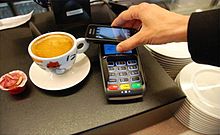
Some mobile phones can make mobile payments via direct mobile billing schemes, or through contactless payments if the phone and the point of sale support near field communication (NFC). Enabling contactless payments through NFC-equipped mobile phones requires the co-operation of manufacturers, network operators, and retail merchants.
Some apps allows for sending and receiving facsimile (Fax), over a smartphone, including facsimile data (composed of raster bi-level graphics) generated directly and digitally from document and image file formats.
The rise in popularity of touchscreen smartphones and mobile apps distributed via app stores along with rapidly advancing network, mobile processor, and storage technologies led to a convergence where separate mobile phones, organizers, and portable media players were replaced by a smartphone as the single device most people carried. Advances in digital camera sensors and on-device image processing software more gradually led to smartphones replacing simpler cameras for photographs and video recording. The built-in GPS capabilities and mapping apps on smartphones largely replaced stand-alone satellite navigation devices, and paper maps became less common. Mobile gaming on smartphones greatly grew in popularity, allowing many people to use them in place of handheld game consoles, and some companies tried creating game console/phone hybrids based on phone hardware and software. People frequently have chosen not to get fixed-line telephone service in favor of smartphones. Music streaming apps and services have grown rapidly in popularity, serving the same use as listening to music stations on a terrestrial or satellite radio. Streaming video services are easily accessed via smartphone apps and can be used in place of watching television. People have often stopped wearing wristwatches in favor of checking the time on their smartphones, and many use the clock features on their phones in place of alarm clocks.
Additionally, in many lesser technologically developed regions smartphones are people's first and only means of Internet access due to their portability, with personal computers being relatively uncommon outside of business use. The cameras on smartphones can be used to photograph documents and send them via email or messaging in place of using fax (facsimile) machines. Payment apps and services on smartphones allow people to make less use of wallets, purses, credit and debit cards, and cash. Mobile banking apps can allow people to deposit checks simply by photographing them, eliminating the need to take the physical check to an ATM or teller. Guide book apps can take the place of paper travel and restaurant/business guides, museum brochures, and dedicated audio guide equipment.
In 2012, University of Southern California study found that unprotected adolescent sexual activity was more common among owners of smartphones. A study conducted by the Rensselaer Polytechnic Institute's (RPI) Lighting Research Center (LRC) concluded that smartphones, or any backlit devices, can seriously affect sleep cycles. Some persons might become psychologically attached to smartphones resulting in anxiety when separated from the devices. A "smombie" (a combination of "smartphone" and "zombie") is a walking person using a smartphone and not paying attention as they walk, possibly risking an accident in the process, an increasing social phenomenon. The issue of slow-moving smartphone users led to the temporary creation of a "mobile lane" for walking in Chongqing, China. The issue of distracted smartphone users led the city of Augsburg, Germany to embed pedestrian traffic lights in the pavement.
Mobile phone use while driving—including calling, text messaging, playing media, web browsing, gaming, using mapping apps or operating other phone features—is common but controversial, since it is widely considered dangerous due to what is known as distracted driving. Being distracted while operating a motor vehicle has been shown to increase the risk of accidents. In September 2010, the US National Highway Traffic Safety Administration (NHTSA) reported that 995 people were killed by drivers distracted by phones. In March 2011 a US insurance company, State Farm Insurance, announced the results of a study which showed 19% of drivers surveyed accessed the Internet on a smartphone while driving. Many jurisdictions prohibit the use of mobile phones while driving. In Egypt, Israel, Japan, Portugal and Singapore, both handheld and hands-free calling on a mobile phone (which uses a speakerphone) is banned. In other countries including the UK and France and in many US states, only the use of calling on handheld phones is banned, while hands-free use is permitted.
A 2011 study reported that over 90% of college students surveyed text (initiate, reply or read) while driving. The scientific literature on the danger of driving while sending a text message from a mobile phone, or texting while driving, is limited. A simulation study at the University of Utah found a sixfold increase in distraction-related accidents when texting.dead link Due to the complexity of smartphones that began to grow more after, this has introduced additional difficulties for law enforcement officials when attempting to distinguish one usage from another in drivers using their devices. This is more apparent in countries which ban both handheld and hands-free usage, rather than those which ban handheld use only, as officials cannot easily tell which function of the phone is being used simply by looking at the driver. This can lead to drivers being stopped for using their device illegally for a call when, in fact, they were using the device legally, for example, when using the phone's incorporated controls for car stereo, GPS or satnav.
A 2010 study reviewed the incidence of phone use while cycling and its effects on behavior and safety. In 2013 a national survey in the US reported the number of drivers who reported using their phones to access the Internet while driving had risen to nearly one of four. A study conducted by the University of Vienna examined approaches for reducing inappropriate and problematic use of mobile phones, such as using phones while driving.
Accidents involving a driver being distracted by being in a call on a phone have begun to be prosecuted as negligence similar to speeding. In the United Kingdom, from 27 February 2007, motorists who are caught using a handheld phone while driving will have three penalty points added to their license in addition to the fine of £60. This increase was introduced to try to stem the increase in drivers ignoring the law. Japan prohibits all use of phones while driving, including use of hands-free devices. New Zealand has banned handheld phone use since 1 November 2009. Many states in the United States have banned text messaging on phones while driving. Illinois became the 17th American state to enforce this law. As of July 2010, 30 states had banned texting while driving, with Kentucky becoming the most recent addition on July 15.
Public Health Law Research maintains a list of distracted driving laws in the United States. This database of laws provides a comprehensive view of the provisions of laws that restrict the use of mobile devices while driving for all 50 states and the District of Columbia between 1992, when first law was passed through December 1, 2010. The dataset contains information on 22 dichotomous, continuous or categorical variables including, for example, activities regulated (e.g., texting versus talking, hands-free versus handheld calls, web browsing, gaming), targeted populations, and exemptions.
A "patent war" between Samsung and Apple started when the latter claimed that the original Galaxy S Android phone copied the interface—and possibly the hardware—of Apple's iOS for the iPhone 3GS. There was also smartphone patents licensing and litigation involving Sony Mobile, Google, Apple Inc., Samsung, Microsoft, Nokia, Motorola, HTC, Huawei and ZTE, among others. The conflict is part of the wider "patent wars" between multinational technology and software corporations. To secure and increase market share, companies granted a patent can sue to prevent competitors from using the methods the patent covers. Since the 2010s the number of lawsuits, counter-suits, and trade complaints based on patents and designs in the market for smartphones, and devices based on smartphone OSes such as Android and iOS, has increased significantly. Initial suits, countersuits, rulings, license agreements, and other major events began in 2009 as the smartphone market stated to grow more rapidly by 2012.
With the rise in number of mobile medical apps in the market place, government regulatory agencies raised concerns on the safety of the use of such applications. These concerns were transformed into regulation initiatives worldwide with the aim of safeguarding users from untrusted medical advice.
Smartphone malware is easily distributed through an insecure app store. Often, malware is hidden in pirated versions of legitimate apps, which are then distributed through third-party app stores. Malware risk also comes from what is known as an "update attack", where a legitimate application is later changed to include a malware component, which users then install when they are notified that the app has been updated. As well, one out of three robberies in 2012 in the United States involved the theft of a mobile phone. An online petition has urged smartphone makers to install kill switches in their devices. In 2014, Apple's "Find my iPhone" and Google's "Android Device Manager" can locate, disable, and wipe the data from phones that have been lost or stolen. With BlackBerry Protect in OS version 10.3.2, devices can be rendered unrecoverable to even BlackBerry's own Operating System recovery tools if incorrectly authenticated or dissociated from their account.
Leaked documents published by WikiLeaks, codenamed Vault 7 and dated from 2013–2016, detail the capabilities of the United States Central Intelligence Agency (CIA) to perform electronic surveillance and cyber warfare, including the ability to compromise the operating systems of most smartphones (including iOS and Android).
Guidelines for mobile device security were issued by NIST and many other organizations. For conducting a private, in-person meeting, at least one site recommends that the user switch the smartphone off and disconnect the battery.
Using smartphones late at night can disturb sleep, due to the blue light and brightly lit screen, which affects melatonin levels and sleep cycles. In an effort to alleviate these issues, "Night Mode" functionality to change the color temperature of a screen to a warmer hue based on the time of day to reduce the amount of blue light generated became available through several apps for Android and the f.lux software for jailbroken iPhones. iOS 9.3 integrated a similar, system-level feature known as "Night Shift." Several Android device manufacturers bypassed Google's initial reluctance to make Night Mode a standard feature in Android and included software for it on their hardware under varying names, before Android Oreo added it to the OS for compatible devices.
It has also been theorized that for some users, addiction to use of their phones, especially before they go to bed, can result in "ego depletion." Many people also use their phones as alarm clocks, which can also lead to loss of sleep.
Comments
Post a Comment