Use
Mobile banking and payment
In many countries, mobile phones are used to provide mobile banking services, which may include the ability to transfer cash payments by secure SMS text message. Kenya's M-PESA mobile banking service, for example, allows customers of the mobile phone operator Safaricom to hold cash balances which are recorded on their SIM cards. Cash can be deposited or withdrawn from M-PESA accounts at Safaricom retail outlets located throughout the country and can be transferred electronically from person to person and used to pay bills to companies.
Branchless banking has been successful in South Africa and the Philippines. A pilot project in Bali was launched in 2011 by the International Finance Corporation and an Indonesian bank, Bank Mandiri.
Another application of mobile banking technology is Zidisha, a US-based nonprofit micro-lending platform that allows residents of developing countries to raise small business loans from Web users worldwide. Zidisha uses mobile banking for loan disbursements and repayments, transferring funds from lenders in the United States to borrowers in rural Africa who have mobile phones and can use the Internet.
Mobile payments were first trialled in Finland in 1998 when two Coca-Cola vending machines in Espoo were enabled to work with SMS payments. Eventually, the idea spread and in 1999, the Philippines launched the country's first commercial mobile payments systems with mobile operators Globe and Smart.
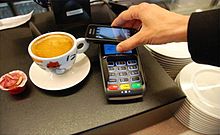
Some mobile phones can make mobile payments via direct mobile billing schemes, or through contactless payments if the phone and the point of sale support near field communication (NFC). Enabling contactless payments through NFC-equipped mobile phones requires the co-operation of manufacturers, network operators, and retail merchants.
Facsimile
Some apps allows for sending and receiving facsimile (Fax), over a smartphone, including facsimile data (composed of raster bi-level graphics) generated directly and digitally from document and image file formats.
Convergence with other devices
The rise in popularity of touchscreen smartphones and mobile apps distributed via app stores along with rapidly advancing network, mobile processor, and storage technologies led to a convergence where separate mobile phones, organizers, and portable media players were replaced by a smartphone as the single device most people carried. Advances in digital camera sensors and on-device image processing software more gradually led to smartphones replacing simpler cameras for photographs and video recording. The built-in GPS capabilities and mapping apps on smartphones largely replaced stand-alone satellite navigation devices, and paper maps became less common. Mobile gaming on smartphones greatly grew in popularity, allowing many people to use them in place of handheld game consoles, and some companies tried creating game console/phone hybrids based on phone hardware and software. People frequently have chosen not to get fixed-line telephone service in favor of smartphones. Music streaming apps and services have grown rapidly in popularity, serving the same use as listening to music stations on a terrestrial or satellite radio. Streaming video services are easily accessed via smartphone apps and can be used in place of watching television. People have often stopped wearing wristwatches in favor of checking the time on their smartphones, and many use the clock features on their phones in place of alarm clocks.
Additionally, in many lesser technologically developed regions smartphones are people's first and only means of Internet access due to their portability, with personal computers being relatively uncommon outside of business use. The cameras on smartphones can be used to photograph documents and send them via email or messaging in place of using fax (facsimile) machines. Payment apps and services on smartphones allow people to make less use of wallets, purses, credit and debit cards, and cash. Mobile banking apps can allow people to deposit checks simply by photographing them, eliminating the need to take the physical check to an ATM or teller. Guide book apps can take the place of paper travel and restaurant/business guides, museum brochures, and dedicated audio guide equipment.
Comments
Post a Comment